Vinciolo's Lace
A Venetian lace designer's woodcuts from 1603, the rules his symmetric designs never break, and the numbers that count every design obeying them.
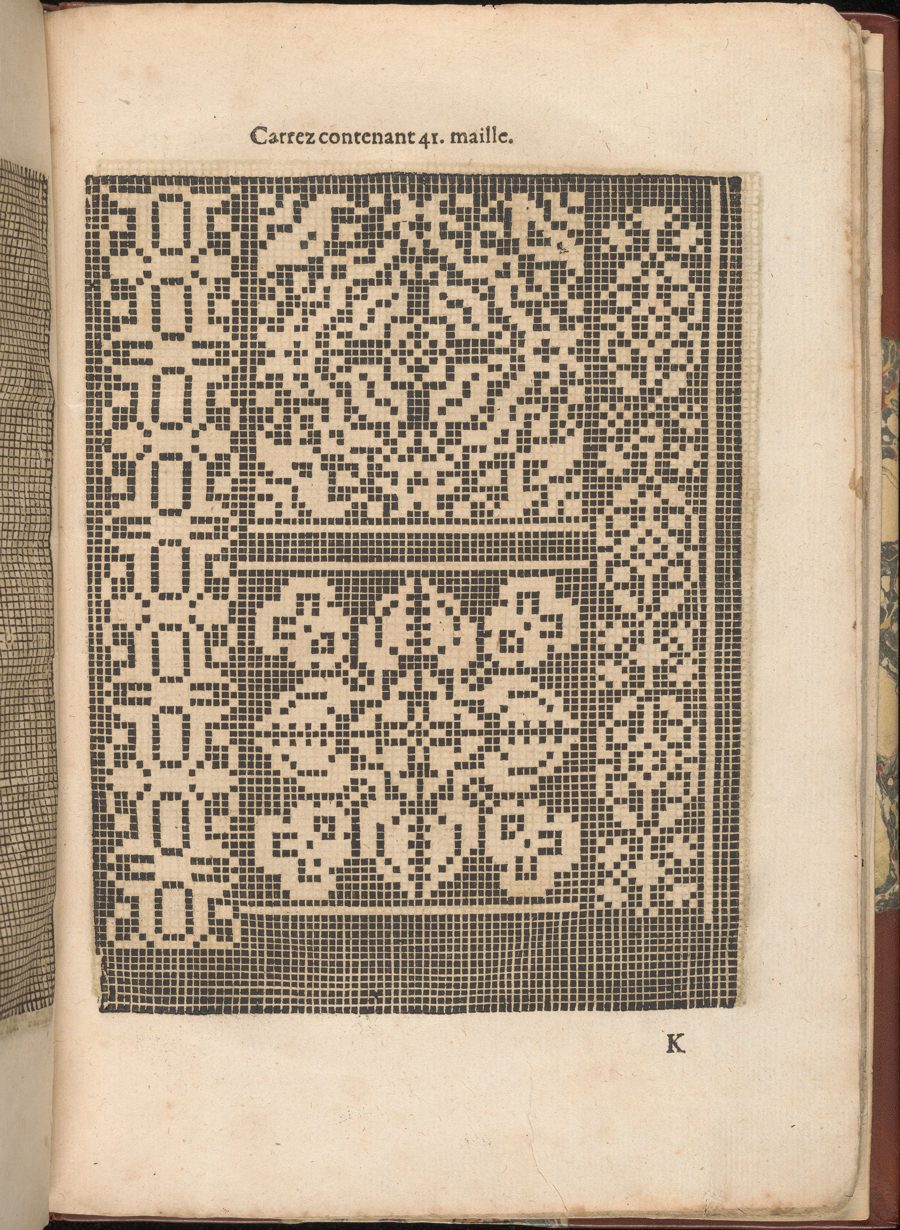
This page started with a question: the two square panels in the middle of this plate look a lot like the symmetric sandpile pictures of another sequence. Are they related?
They are not. But tracing them, and then every other symmetric design in the book, turned up something else: out of the 512 ways a 3 × 3 patch of lace can look, Vinciolo uses 511. The one he never draws is an open mesh walled in on all eight sides.
That rule defines a new integer sequence: the number of fully symmetric n × n designs with no such "pinhole". For the 43 × 43 squares of this plate there are about 3.2 × 1075 of them.
The pinhole turns out to be the smallest case of a stronger rule: Vinciolo never walls in a pocket of fewer than 5 open meshes. Letting the smallest allowed pocket vary gives a whole table of counts.
Jump to: the artist · lacis · tracing · the 19 panels · the rule · no small pockets · try it · his patch mix · the sequence · the table
Federico de Vinciolo
Federico de Vinciolo was a Venetian designer of lace and needlework who worked in Paris in the late sixteenth century; the Metropolitan Museum records him as active there from about 1587 to 1599. Little is documented about his life. Tradition holds that he came to France under the patronage of Catherine de' Medici and that he was granted a privilege for making the lace ruffs then in fashion at court.
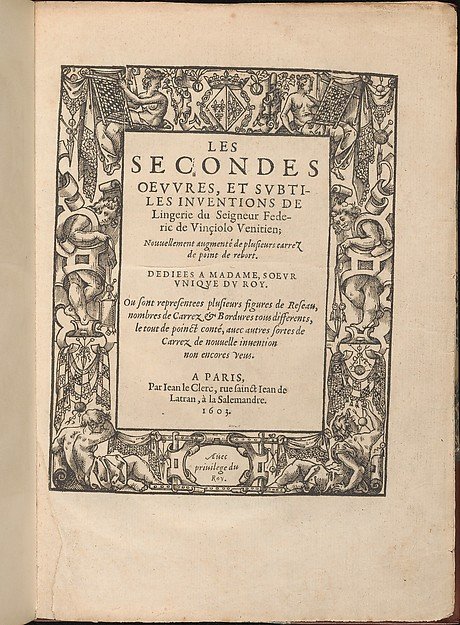
He is remembered for his pattern books. Les Singuliers et Nouveaux Pourtraicts, first printed in Paris in 1587, went through many editions until 1623. It was followed in 1603 by Les Secondes Oeuvres, et Subtiles Inventions de Lingerie, printed by Jean Le Clerc "at the sign of the Salamander" in the rue Saint-Jean de Latran, and dedicated to "Madame, soeur unique du Roy": Catherine de Bourbon (1558–1604), the only sister of Henry IV.
The title page promises "several figures of net, numbers of squares and borders, all different, all in counted stitch." The book has about 64 pages of designs: a few pictorial scenes and coats of arms, and dozens of square charts for lace, each printed from a carved woodblock.
Lacis: lace on a square net
Most of Vinciolo's charts are for lacis, also called filet or darned netting. The lacemaker first knots a net of square meshes, then darns thread back and forth through chosen meshes to fill them in; the rest stay open. A design is therefore a grid in which every square is either filled or empty, which a woodcut can print exactly: a black square is a darned mesh, a blank square an open one. "Carrez contenant 41. maille" means "squares containing 41 meshes."
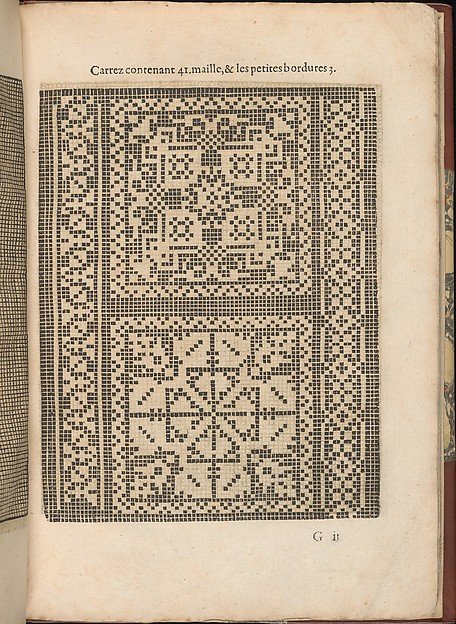
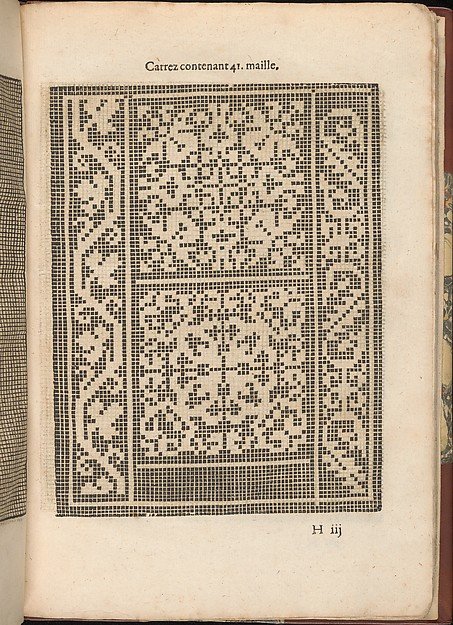
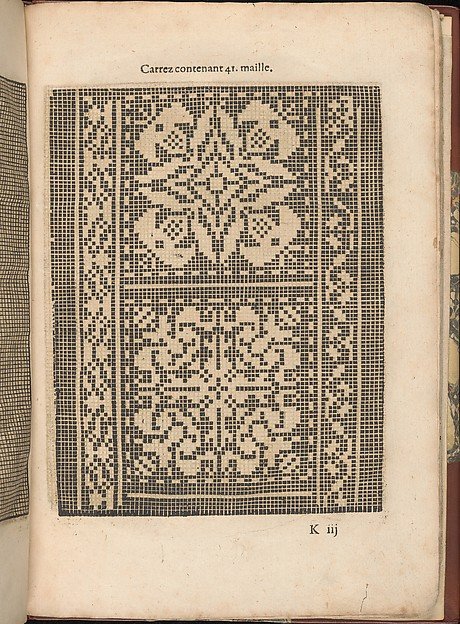
Plates from Les Secondes Oeuvres, The Metropolitan Museum of Art, Harris Brisbane Dick Fund, 1939 (39.30), public domain.
From woodcut to grid
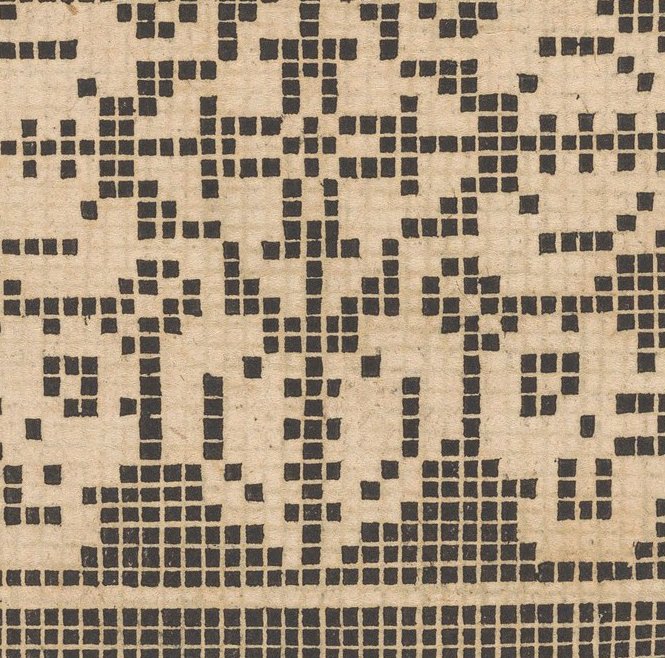
A program finds every printed square in the photograph, then walks from square to square, rounding each step to the local mesh size, so that the grid follows the slight curve of the page. Empty positions are open meshes. Two different photographs of page 37 trace to grids that agree on 98% of cells.
Many panels are drawn to look the same after any rotation or reflection of the square, the eight symmetries of a square tile. A second program searches each traced page for square windows that sit on Vinciolo's solid frame line and match their eight symmetric copies on at least 90% of cells (the rest are tracing errors or the carver's slips, fixed by a majority vote over the eight copies).
The 19 symmetric panels
Thirteen plates give 19 fully symmetric panels, from 43 × 43 to 61 × 61 meshes, frame included. Click one to open it in the editor below.
The one rule he never breaks
Slide a 3 × 3 window over every position of every panel, counting the dark frame as darned. There are 29 = 512 possible patterns in such a window. Vinciolo's 19 panels contain 511 of them.
The missing one is a pinhole: a single open mesh with all eight neighbors darned. In random symmetric designs of the same density it would turn up about 120 times; Vinciolo never draws it. Other patterns are rare, the checkerboard and X shapes most of all, but each appears somewhere.
Rarest 3 × 3 patterns, counted with all their rotations and reflections, over windows. "Expected" is the count in random designs with the same share of darned meshes.
The rule makes sense in lace: a lone open mesh surrounded by darning tends to close up and read as a flaw, while a lone darned mesh in open net is a clear dot, and Vinciolo uses those freely, for example as the centers of flowers. Rules that sound just as natural fail: the open meshes form one connected region in only 10 of the 19 panels.
A stronger rule: no small pockets
A pinhole is a pocket of one open mesh walled in by darning. What about pockets of two, three or four meshes? Call a pocket any group of open meshes that touch each other, along a side or just at a corner, with darned meshes (or the frame) all around. In all 19 panels, every pocket has at least 5 meshes.
Pockets of 1, 2, 3 and 4 open meshes never occur. The 5-mesh cross does, exactly once, at the center of the page 23 panel. All other pockets in the panels have 9 meshes or many more.
Corners count as connections. A single open mesh whose four sides are darned but which touches open net at a corner is not a pocket: it belongs to the larger region. Vinciolo uses that move constantly. It makes his stepped diagonal lines and checkerboard textures, and there are 1,792 such corner-joined spots in the 19 panels.
Is 5 just luck? For each panel, 20 random symmetric designs of the same size and the same share of darning, all free of pinholes, give the comparison below. Vinciolo's open meshes form one web around his motifs, while the random designs scatter into many small pockets. The chance that 19 random designs would all avoid pockets under 5 is below one in a hundred million.
Away from the center, the bound is 9. The 5-mesh cross sits on the exact center, where all eight mirror images of a pocket fall on top of each other. Leave out the pocket through the center and the smallest pocket left has 9 meshes. Pockets of 1 to 8 meshes never occur anywhere else. Against the same random designs, the chance that all 19 panels would pass by luck is roughly one in 1011. One caution: the 9-mesh pockets all come from a single panel (page 31, eight mirror copies of the shape above). Without that panel the smallest pocket away from the center would have 66 meshes. The random designs on this page use the rule "no pocket under 9 meshes, except through the center".
Rules about how a design grows fail. We tested 24 versions of "every open (or darned) mesh touches one of its own kind that is closer to the center (or to the frame)", with square, diamond and round distances, counting side or corner neighbors. Every version is broken in every one of the 19 panels, because the scrolls, hooks and flower heads curl back toward the center. On the darned side there is no pocket rule either: islands of two darned meshes occur in two panels.
Try it
Click or drag to darn or open a mesh; its seven symmetric partners follow. Open meshes in pockets smaller than k are marked in red (with k = 2 these are the pinholes; with Vinciolo's rule, the pocket through the center may be any size). "Random design" draws a random design that obeys the rule for the chosen k. Vinciolo's panels all pass with k = 5, and with k = 9 if the pocket through the center is exempt. "Export" saves the design as a picture with its darned frame (black on white), or as a text grid of the n × n design without the frame.
Designing with Vinciolo's patch mix
Rules say what Vinciolo never does. To capture what he likes to do, count how often he uses each kind of 3 × 3 patch. Up to rotation and reflection there are 102 kinds; he uses 101 of them, some far more than chance would give and some far less. The generator below makes random symmetric designs in which every kind of patch turns up as often as it does in his 19 panels, and which are otherwise as random as possible. They also obey his pocket rule: no open pocket under 9 meshes except through the center.
Eight designs made the same way, at Vinciolo's usual 43 × 43:
How it works: each kind of patch gets a weight, and a design's probability is the product of the weights of all its patches. The weights were tuned until designs drawn from the model use every kind of patch as often as Vinciolo does. This is the maximum-entropy model for his patch counts: it builds in those counts and nothing more. The designs are drawn by flipping one symmetric set of meshes at a time and keeping or undoing each flip at random according to the weights, and always undoing a flip that would leave a small pocket. The weights were fitted without the pocket rule; adding it changes the patch counts very little, since about 4 in 10 designs already obey it by themselves.
The match is close, not exact. The table shows the patch kinds where rule-only random designs (no pinholes, same amount of darning) miss Vinciolo's usage the most. Over all patches,
The model reproduces his texture: solid bars and frames, stepped diagonals, open fields edged with darning, small medallions. It does not reproduce his motifs. A flower, a scroll or a heraldic shape spans far more than 3 × 3 meshes, and nothing in the patch counts says how to build one.
The sequence
a(n) = the number of n × n arrays of darned and open meshes, unchanged by the 8 symmetries of the square, with no open mesh whose 8 neighbors are all darned (meshes outside the square count as darned).
Writing 1 for open and 0 for darned, this is the number of symmetric n × n binary arrays in which every 1 has a neighboring 1, horizontally, vertically or diagonally. Without the symmetry it is OEIS A202788. The first terms are 1, 2, 6, 7, 48, 55, 705, 861, 21454, …; for n = 3, the six designs are the ones where the open meshes are none, the edges, the edges and center, the corners and center, the corners and edges, or all nine.
A symmetric design is fixed by one eighth of the square, ⌈n/2⌉(⌈n/2⌉+1)/2 cells, so there are at most 2253 symmetric 43 × 43 designs; the rule leaves . The terms up to n = 47 were computed by a transfer matrix over that eighth: the cells are placed one at a time, and for each cell still needed the program remembers only whether it is open and whether it already has an open neighbor. The counts were checked by brute force for n ≤ 14 and by two independent arithmetics at n = 43. The method, the checks and all the programs are in oeis-results/vinciolo-lace.
The table: every pocket size
T(n,k) = the number of symmetric n × n designs in which every pocket of open meshes has at least k meshes.
Column k = 2 is the sequence above, and column k = 5 counts the designs that obey Vinciolo's stronger rule. Column k = 1 has no restriction, so it counts all 2⌈n/2⌉(⌈n/2⌉+1)/2 symmetric designs. Each row falls as k grows and reaches 1 (only the fully darned design) once k exceeds n². Read by antidiagonals, T(1,1), T(1,2), T(2,1), …, the table is submitted to the OEIS as one entry. It is computed for every n + k ≤ , which makes terms, and for some further entries.
Counting pockets needs more memory than counting pinholes. The program still builds one eighth of the design, but it has to remember, for each open region still in progress, how many meshes it covers in the whole square. A region that crosses a mirror line is its own mirror image, so the program also records which mirror lines each region touches, which tells it how many copies of the eighth make up the region. The largest runs held 50 million partial designs in memory at once. All the numbers were checked by brute force for n ≤ 12, by a second program, and against the sequence above.